
Karate Classes for Adults & Teens in Brighton & Westminster
Adult and teen karate classes for people who have never trained before, and for people coming back to it. Traditional Shotokan at two Colorado dojos.
Students train by rank — Beginner, Intermediate, Advanced, and Black Belt — not by age, so everyone works alongside others at their own level. Pre-Karate is our one age-specific class.
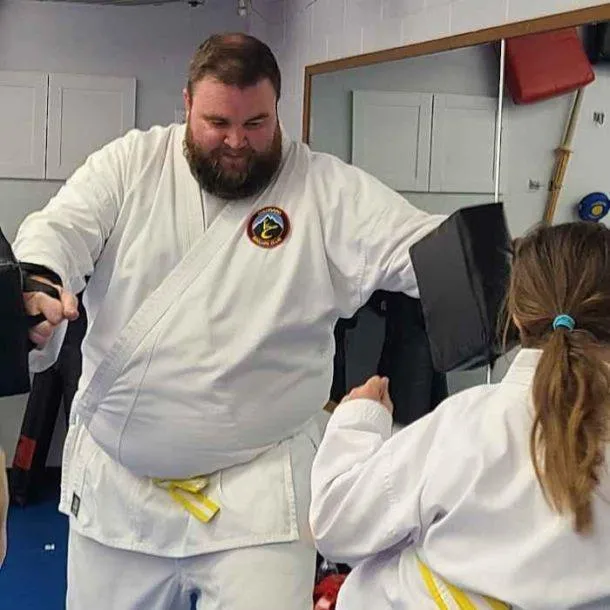
What an adult karate class is actually like
You line up, bow in, and warm up with everyone else. Then it is stances, blocks, strikes and kicks, the same handful of movements, drilled until they stop requiring thought. Later in the class you work them with a partner or against a pad.
It is not a fitness class with karate branding, and it is not sparring from day one. It is traditional Shotokan: technique first, standards held, progress measured by what you can demonstrate rather than by how long you have attended.
Starting as a complete beginner
Most adults who walk in have never done a martial art. That is the normal case here, not the exception, and the beginner class exists precisely for it.
You are grouped by rank rather than by age, so you learn beside other people working on the same things you are. Nobody is going to put a first-week white belt across from a black belt and see what happens.
What it does to your body
Karate is unusual among adult fitness options in that the conditioning is a side effect rather than the point. You are not counting reps. You are trying to get a technique right, repeatedly, and the strength, balance and mobility follow from that.
It also asks for a kind of attention that most of the day does not. For the length of the class there is one thing to think about.
Practical self-defense
The self-defense in traditional karate is not theatrical. It is distance, timing, and the ability to move decisively when something is already happening.
It is taught alongside judgement about when not to use it. That balance is the same one we teach children, and it does not change for adults.
Belts, and how progress works
Beginners test for promotion every two months. Intermediate and advanced ranks are promoted on individual progress rather than a schedule, because what each rank asks for grows steeper.
The club runs two in-house tournaments a year. Competing is entirely optional, and many adults never enter one. But the option is there for people who want a deadline attached to their training.
What to wear, and what is included
For a first session, comfortable clothes you can move in. Nothing to buy first.
On enrollment, the one-time registration fee covers your uniform (gi), all required protective equipment, belt testing, both in-house tournaments and seminars, so the cost of training is the membership, without equipment bills appearing later in the year.
Where and when adult classes run
Both dojos train Monday through Thursday. Classes are grouped by rank rather than by age, so an adult starting out trains in the beginner class, the same one a beginner of any age joins, early in the evening rather than late. Brighton has been on South Main Street since 2005; Westminster opened on West 80th Avenue in 2020, and each has its own black-belt head instructor.
The introductory session is free. Afterwards we go through how membership works and what it covers, so you can decide with the whole picture rather than on the spot. The schedule page lists every class by day and rank.